
Good grant writers pay attention to the details of everyday life, whether at home, on a walk in the woods, or traveling to distant places. This is because and as we’ve written about before, a compelling grant proposal is really just a story that needs enough detail to convey the project concept and engage the reviewer—if you bore or confuse reviewers, you’ll lose points and lower your chances of being funded. Toward this end [free proposal transition phrase here], when asked about my knowledge about the proposal topic by a prospective client, I tell them that while I may not know much about the concept, my knowledge base in like an oil slick: it is very thin and large but gets wider with every proposal as I write about new topics.
I recently read Chloe Dalton’s wonderful book, Raising Hare: a Memoir, which illustrates this lesson in an extraordinary meditative chronicle of the author’s changed life after she encounters a tiny leveret (baby hare) one day on a walk near her farm in rural England (in America, hares are usually referred to as jackrabbits). Raising Hare is unlike most nature tales, which are usually written in a florid dramatic style involving anthropomorphized animals like the great novel Watership Down about a colony* of rabbits in the English countryside or Born Free about raising a lion cub in Kenya. In contrast, Dalton writes in a simple quiet, yet profound, voice like the “plain style,” my late son and colleague Jake wrote about in 2011 to which we grant writers should strive.
Although published in late 2024, Raising Hare began to be noticed this year after winning the Wainwright Prize for Nature Writing and being a finalist for the Women’s Prize for Nonfiction. I found it by accident but it’s easy to understand the recent acclaim only a few pages in. Dalton is a successful London-based political and foreign policy adviser specialist who retreated to a farm at the start of the COVID-19 lockdowns and hysteria. Her chance encounter with the newborn abandoned leveret during a stroll along a farm track transformed her perspective on life. She first kept her distance from the leveret, knowing that human interference can doom a wild animal. When the mom hare didn’t return after some hours, Dalton brought the leveret into her home for what she thought would be a temporary shelter. She was wrong and developed an unexpected connection as Hare grew over several years. Although Dalton allowed Hare to roam freely in and out of her house by providing a doggy door, Hare was not a pet and remained wild. Along the way we learn that hares, unlike rabbits, have never been domesticated. Put in SAT lingo, a hare is to a rabbit as a zebra is to a horse. For would-be grant writers, this is the kind of obscure fact that can elevate a grant proposal from the mundane and catch the attention of a reviewer.
I found it exceptionally moving that Dalton didn’t give Hare a cute name to respect its wild nature—no Hazel or Fiver like in Watership Down or Elsa in Born Free. Reminds me of the scene in the great 2000 movie Gladiator when Emperor Commodus asks the Russel Crowe character what his name is and he responds, “My name is Gladiator.” She makes it easy for Hare to come and go from her house at will. It sometimes leaves for days to romp in the nearby fields, only to eventually return and curl up near her in the house. As she describes her experiences, Dalton’s prose is lyrical and restrained in its simplicity, blending biological facts with a poet’s sensitivity. She seamlessly interweaves the ordinary daily interactions with captivating dives into hare lore like the “mad as a March hare,” which is derived from the sudden jerky movements of hares and frequent “chest boxing” between two hares. She also describes folklore from many cultures showing how hares, which are naturally elusive, have been misunderstood and persecuted since antiquity. While Dalton reveals that hares are declining in numbers in England due to expanding agriculture and habitat loss, she avoids the environmental preachiness that is common in modern nature articles and books—the population decline of hares is presented organically through quiet observation and research references without resorting to hyperbole and scolding.
Overall, Dalton lifts Raising Hare beyond an appealing wildlife rescue tale by exploring deeper themes—freedom, trust, patience, and the restorative power of slowing down through careful, non-judgmental observation of the natural world around us. She openly shares with the reader how Hare “challenged my priorities and woke up my senses.” While Dalton is raising Hare, Hare is pulling her from a guarded, hyper-vigilant professional life into one of wonder and presence. This is similar to the popular behavioral therapy we write about in SUD/OUD treatment proposals, Mindfulness. As she notes, Hare “needed nothing from me other than that I do no harm,” which resonates as a broader moral imperative for human interactions with wild animals and the natural world.
Since the morphology of male and female hares is the same for us human observers, readers don’t learn that Hare is female until halfway through the book when Hare returns after a two-week absence with three leverets of her own to raise in the garden along with access to the house. Moments of joy like this are tempered with the realities of wildlife, like the death of one of Hare’s leverets and the constant risk of foxes, other predators, and farm equipment. Dalton’s fresh, conversational prose, along with delightful illustrations, are calming to readers in our frantic world, reminding us of the importance of taking time to explore unexpected and sometimes profound connections that can wake us from our everyday slumber. Simply put, Raising Hare is much more than a story about one woman and one hare. Read it not only as a memoire but also as a reminder to take time to attune oneself to the wild world, whether it be watching a scurry of squirrels (yes, this is the term for a group of squirrels) frolicking in Central Park or a herd of elk in Wyoming. A spark of the wild remains deep within us, so discover it in this unsentimental but heartwarming example of nature writing at its finest.
I bought a newly built house in a Phoenix area exurb a few years ago. Unlike my neighbors who love pavers and fake grass, I had the front and back yards landscaped in a bird, bee, and bunny friendly way with lots of trees, flowers, and a patch of natural grass in the back yard for my big Golden Retriever (AKA a lawn hippo). In a serendipitous moment, I had my own brush with the natural world just as I started reading Raising Hare. One day, I noticed that an Anna’s hummingbird had built a tiny next in a desert willow tree in my front yard.
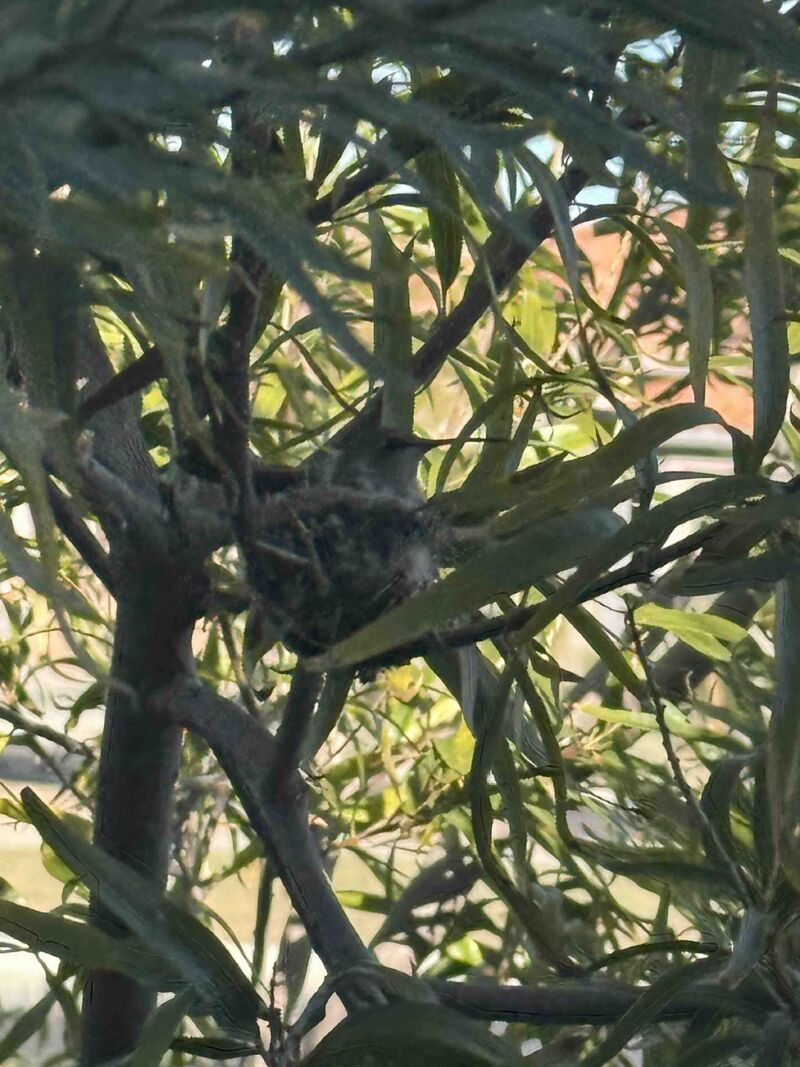
So, I made sure that my hummingbird feeders were clean and filled and was pleased that many of my flowering plants were in bloom. I observe the nest from about 10 feet away every morning and evening because if I get closer, Mrs. Hummingbird will fly around crazily to distract me. Like Dalton learning about hares, I read up on Anna’s hummingbirds. They nest year around in AZ and have a 21-day gestation period before the chicks emerge from their jelly bean-sized eggs. The chicks will soon be old enough to leave the nest, so, while this random event helped me get closer to the natural world, I won’t be writing Raising Hummingbird.
Raising Hare is a great book to read this holiday season for a bit of solace, insight, and renewed sense of awe of the natural world around us. For aspiring grant writers, read it for this reason as well as to experience an example of how simple declarative sentences are very effective in conveying complex subjects without preaching.
* A more affectionate term for a group of rabbits is a “fluffle.” Now you know something else you didn’t know.
2 comments
David
Love this.
Stephen
Yes, this is a wonderful book. It will evoke emotions in you that you never knew you had. And yes, it will give us reflections long after we finish reading it.